Making A Peer Review System for My Blogs Using Google-ADK & Mem0
I needed an automation peer review my blogs, so I used Google-ADK and Mem0 to create an end to end system.

- engineer with a background in AI & Data Science
- love building end-to-end systems that actually solve problems
- curious about AI engineering
- enjoy sharing my journey through technical blogs & projects
- always exploring side projects to learn and grow beyond
My Process
When writing my technical blogs, I have a very rigid process I like to follow.
Research the topic I am interested in
Create a structured research roadmap I require to gain knowledge about the particular topic
Go through the roadmap and try to learn/research the concepts as in-depth as I can
Start coding whatever the relevant implementation for that topic is
Finally, start writing the blog
But one thing always bugs me, "Is my blog factually correct and have I compromised the integrity of my blog anywhere?".
That leads me to frantically go through my sources repeatedly and asking tools like Perplexity about the blog. So, I had the idea to automate this process by a creating a Peer Review System.
What This System Does
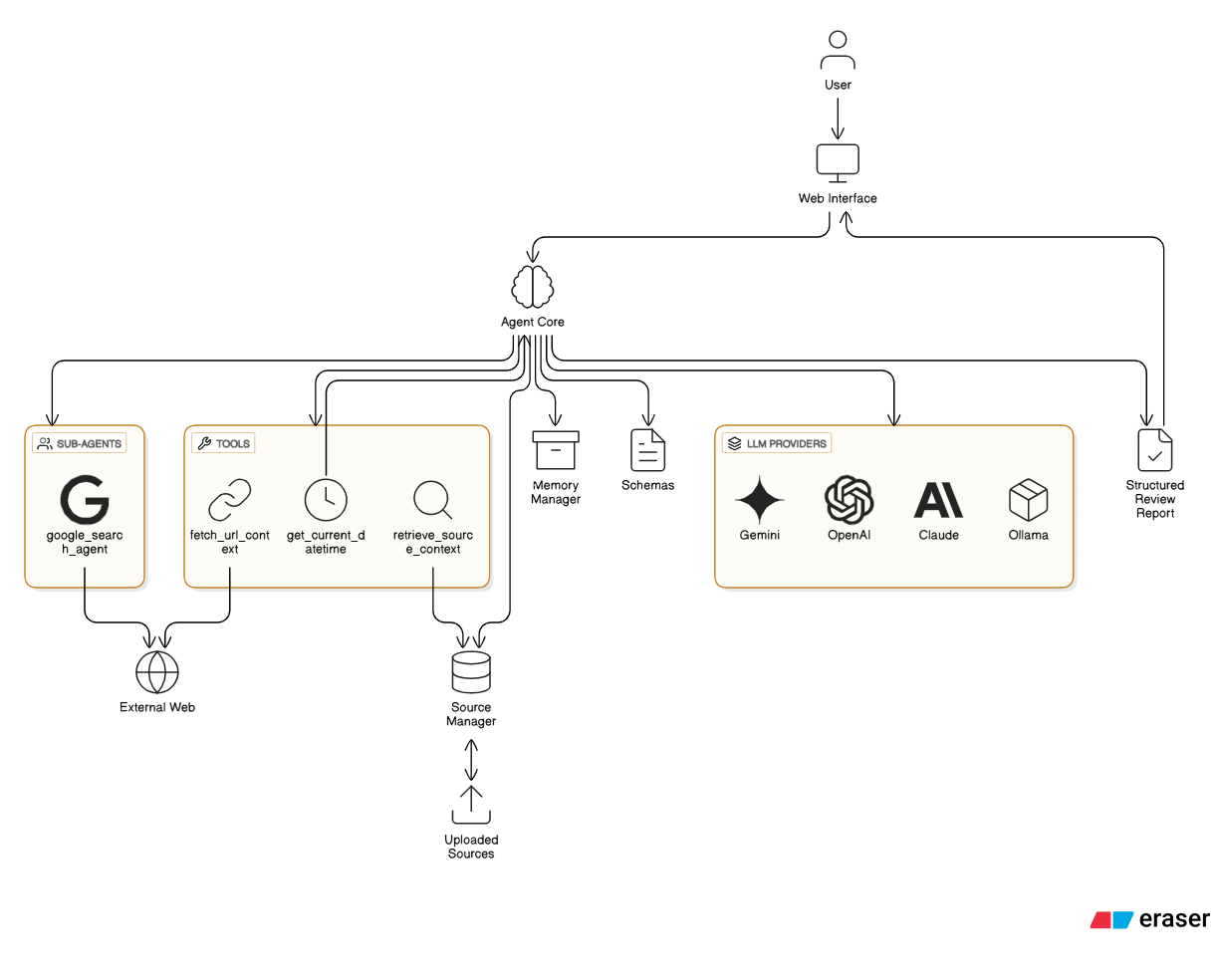
1. What the System Focuses On
It behaves like a technical editor, not just a grammar checker.
It evaluates writing for:
Structure
Clarity
Factual accuracy
Tone correctness
Proper use of supporting evidence
The purpose is to help the writer produce content that is accurate, readable, and consistent.
2. How It Reviews Content
The system doesn’t read content blindly.
It uses uploaded reference files as a knowledge base.
Relevant information from those files is retrieved using semantic search rather than keyword matching.
If a statement appears in the writing:
The system first checks if it exists in the uploaded sources.
If confirmed, the system becomes more confident in that claim.
If not found, it triggers an external web-based fact check.
3. How Memory Improves Review Quality
Feedback adapts over time instead of resetting with each review.
The system tracks repeated mistakes or patterns such as:
Missing citations
Style inconsistencies
Formatting issues
If the same issue shows up again, the system highlights it more firmly.
This turns the review into a learning process rather than a one-time correction.
Screenshots:
https://drive.google.com/file/d/1VTvQBkQ4753NbpVFlVPr5v6_kjH3SXjZ/view?usp=sharing
https://drive.google.com/file/d/14sfHrC0Lw0pvU4oX7U18Ydv61a8RNTu0/view?usp=sharing
A Demo Peer Review Report:
Workflow
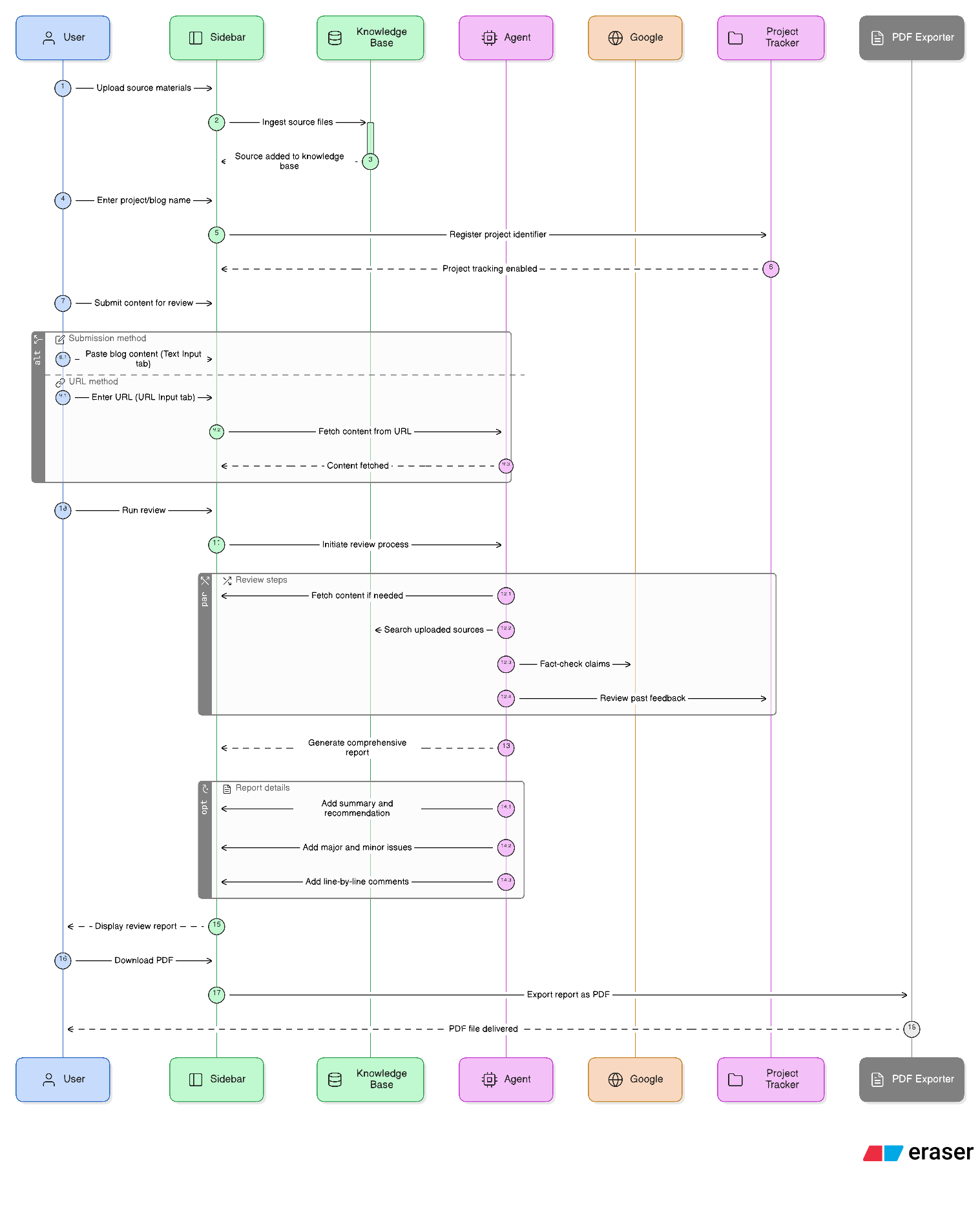
Phase 1: Ingestion
Fetches content from URLs if needed
Loads past review history for the project
Examines uploaded source documents
Phase 2: Verification
Identifies all factual claims in the content
Searches uploaded sources for supporting evidence
Uses Google search for external fact-checking
Validates technical assertions and statistics
Phase 3: Evaluation
Assesses clarity, flow, and structure
Checks accuracy against evidence
Evaluates tone for target audience
Compares to past feedback to track improvement
Flags recurring issues with escalated severity
Phase 4: Synthesis
Generates structured report
Provides evidence for all major issues
References past feedback when relevant
Gives actionable, constructive feedback
Features
1. Model Flexibility
You aren’t locked into one AI provider.
Switching between models like Gemini, Claude, GPT, or Ollama only requires changing one environment variable.
This gives control over:
Cost
Performance
Privacy
The review logic remains consistent across models.
2. Context-Aware Retrieval
Uploaded reference files are stored in a vector database.
The system breaks them into chunks, embeds them, and indexes them for efficient search.
During review, it retrieves relevant sections using semantic similarity rather than simple keyword matching.
This helps the system understand meaning, not just matching exact text.
3. Automated Fact Verification
When a claim isn’t supported by uploaded sources, the system escalates verification.
A separate search agent performs a structured web lookup.
The goal is not to rewrite content, but to confirm whether the information is reliable and accurate.
4. Built-In Memory
The system remembers past reviews and writing patterns.
If a mistake repeats, the system identifies it as a recurring issue.
Instead of pointing it out repeatedly at the same level, the feedback becomes stronger and more specific.
This encourages long-term improvement rather than one-off corrections.
Limitations
The verification is only as good as the model plus the search results
Source reliability isn’t enforced
Web search can surface low quality or outdated material
The model is still the final judge. It can misinterpret sources, over trust weak evidence, or fabricate justification


